
Voice Agents: A deep dive
What It Takes to Build Voice AI: The 800-Millisecond Budget Behind Every Voice Agent

👋 Hi everyone, I am Hamza. I have 18+ years of experience building large-scale machine learning ecosystems, teach at UCLA and MAVEN, and am the founder of Traversaal.ai.
Welcome to Edition #39 of a newsletter that 16,000+ people around the world actually look forward to reading.
🎁 Take the 5-minute sample Claude Code Architect exam to test your Claude Code skills.
🎁 Free course on Claude Code
We’re living through a strange moment: the internet is drowning in polished AI noise that says nothing. This isn’t that. You’ll find raw, honest, human insight here, the kind that challenges how you think, not just what you know. Thanks for being part of a community that still values depth over volume.
🎓 Here’s my Maven’s top rated course on Forward Deployed Engineering

Join today with a special discount, here
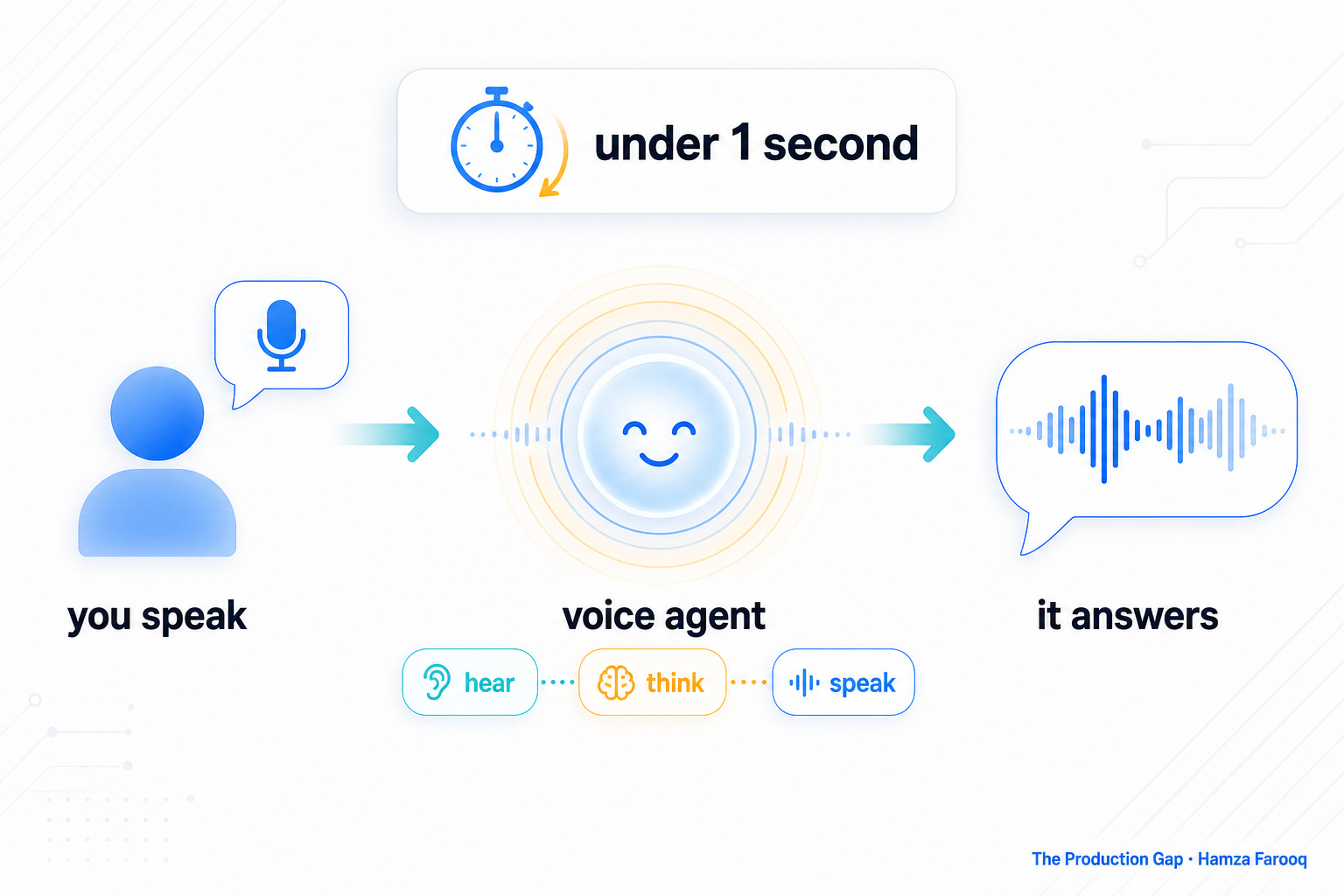
TL;DR: In 2026, a voice agent is one of the strongest bets in applied AI, wherever the channel already fits: phone-native support, hands-busy work, high-volume operations. But the build turns on a single constraint.
You have roughly 700 to 800 milliseconds per conversational turn before it stops feeling human, and every architectural decision, cascading versus speech-to-speech, open versus closed, build versus buy, is a choice about where you spend that budget.
Match the architecture to your latency math, and the bet to your use case, not to the hype.
What It Takes to Build Voice AI: The 800-Millisecond Budget Behind Every Voice Agent
Introduction
Voice is having its moment. Call a business today and you may not be sure whether the thing answering is a person. Demos of agents that book appointments, screen calls, and handle support are everywhere, and after a decade of assistants that mostly set timers and played music, it finally feels like the interface has arrived.
That is exactly why the mistakes are getting expensive.
A team we later worked with at Traversaal opened their first voice AI meeting with a confident question: “Should we use ElevenLabs or OpenAI for this?” They had a vendor shortlist and a sprint planned. But look closely at the question. ElevenLabs is a text-to-speech company; OpenAI’s Realtime API is a full speech-to-speech platform. They were weighing one slice of the pipeline against an entire architecture, the tell that they were choosing tools before they understood the problem. What they didn’t have was a latency budget. Six weeks later they had a beautiful-sounding agent that felt like talking to a loading spinner. Needless to say, that version never shipped.
July 2026 is a genuine inflection point, and the capital knows it. Analysts put the broader conversational AI market north of $40 billion by 2030, with voice agents its fastest-growing slice, and most large enterprises now report deploying or piloting voice AI in customer operations. The tooling caught up to the ambition: OpenAI’s Realtime API, Google’s Gemini Live, and a maturing open-source stack around Whisper, Kokoro, and LiveKit have made production-grade voice agents buildable without a dedicated audio-engineering team.
But the money is running ahead of the trust. In consumer surveys tracked from late 2025 into 2026, preference for a human agent climbed to around 85 percent while preference for AI slipped to 5, frustration rose, and nearly a third of people said they would hang up the moment they realized they were talking to a bot. The strange part: in blind tests, most consumers can no longer reliably tell an AI voice from a human one.
The voices are good enough; the trust is not. Add Alexa’s retreat from ambient computing, years of IVR-hell disappointment, and rising regulatory scrutiny of voice biometric data, under GDPR and a wave of new US state laws, and these architectural choices now carry legal and reputational weight, not just UX weight.
Think of a voice turn like a restaurant ticket. The kitchen has a fixed window to plate the dish before the experience degrades. Every pipeline stage is a cook; every millisecond is a resource.
The framework governing all of it is the Turn Budget, and every architectural decision in a voice agent is a latency allocation decision within it.
Key Takeaways
📈 The money is ahead of the trust, Voice AI is a multi-billion-dollar market and most large enterprises are deploying, yet consumer preference for human agents is climbing, not falling. The engineering job is to earn trust, not just sound human.
⏱️ The turn budget is everything, Every architectural decision in a voice agent comes down to how you slice roughly 800 milliseconds across pipeline stages before conversation feels broken.
🔗 Cascading pipelines trade speed for control, Separate STT, LLM, and TTS components give you stage-level visibility and guardrails, but latency accumulates fast at every handoff.
🎙️ Speech-to-speech removes your safety nets, Native audio models like OpenAI’s gpt-realtime and Google’s Gemini Live cut latency but eliminate the checkpoints where you catch errors, enforce compliance, or inspect what the model heard.
🧩 Open source wins some slices, not all, Whisper and Kokoro are competitive for transcription and synthesis, but self-hosting carries real infrastructure costs that closed APIs often beat on total cost of ownership at moderate scale.
📵 Voice earns its keep in specific contexts, Hands-busy workflows, phone-native channels, and accessibility use cases are where voice makes sense; anywhere a user can comfortably type, voice adds friction.
⚠️ Failure modes are the honest story, Noisy-environment transcription errors, barge-in failures, and PII exposure mean the real question in 2026 isn’t whether you can ship a voice agent, but whether the use case justifies the risk.
What is voice AI agent architecture, and why does latency define everything?
A voice AI agent architecture is the ordered sequence of real-time processing stages, detection, transcription, reasoning, and synthesis, that must complete a full cycle within roughly 800 milliseconds before human conversation feels broken.
