

👋 Hi everyone, I am Hamza. I have 18 years of building large scale ecosystems and I teach at UCLA and MAVEN, and founder of Traversaal.ai.
Welcome to Edition #31 of a newsletter that 15,000+ people around the world actually look forward to reading.
We’re living through a strange moment: the internet is drowning in polished AI noise that says nothing. This isn’t that. You’ll find raw, honest, human insight here, the kind that challenges how you think, not just what you know. Thanks for being part of a community that still values depth over volume.
🎓 Want to up skill as AI Engineer?
Join the next cohort of my Agent Engineering Bootcamp (Developers Edition) May 5th
Watch the free 4-session Agent Bootcamp playlist on YouTube
I’ve been running the same five PM prompts through every major Claude release for the past year. When Opus 4.7 dropped and Reddit immediately declared it a regression, I went back to my test bench. Here’s what the data actually shows.
The moment Claude Opus 4.7 shipped, the backlash hit fast.
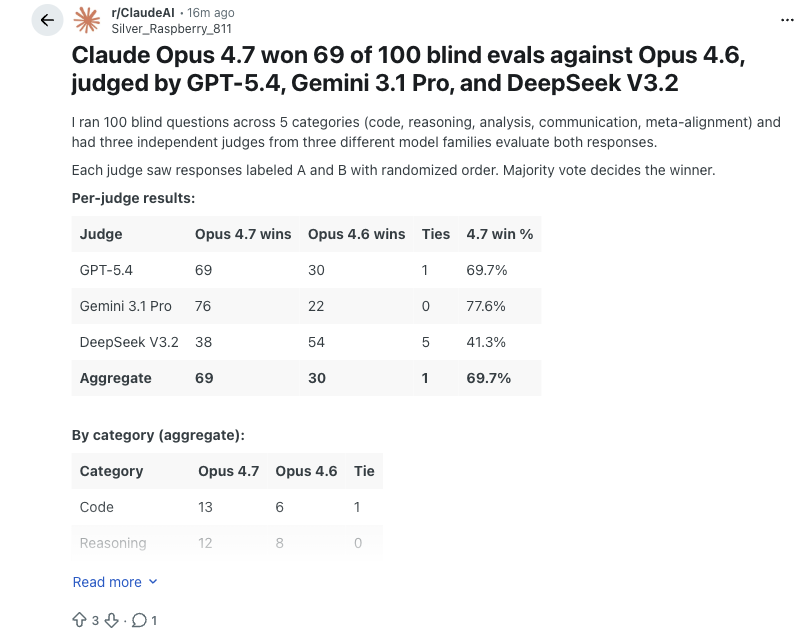
Threads on Reddit, HackerNews, and Twitter/X filled up with complaints: degraded creative writing, over-formatted outputs, a loss of the conversational “warmth” that made earlier Claude models feel different from GPT-4. Scroll far enough and you’d think Anthropic shipped a downgrade. Almost none of it came from product managers using Claude for structured, deliverable-focused work.
Scroll far enough and you’d think Anthropic shipped a downgrade. Almost none of it came from product managers using Claude for structured, deliverable-focused work.
So I went back to my test bench.
Same five PM prompts, both models, fresh sessions with identical context and no fine-tuning, raw first outputs side by side.
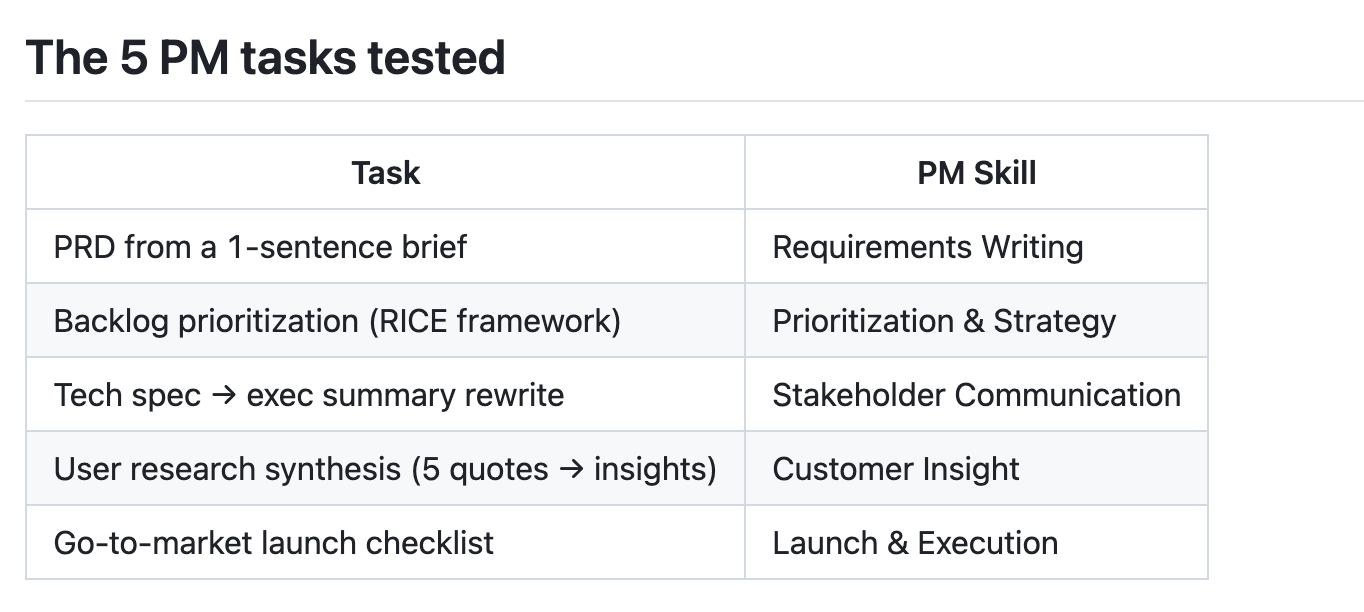
The tasks: PRD writing, exec summary writing, RICE prioritization, user research synthesis, and GTM planning. What follows is the actual output comparison.
One thing I didn’t see covered anywhere else: 4.7’s mid-output self-correction behavior. It shows up in the RICE scoring and user research tasks and it changes how you should think about using it in agentic workflows.
We’ll get to that.
Key takeaways
4.7 is faster and more structured, but whether that’s better depends entirely on the task.
For tables, checklists, and stakeholder-ready docs, 4.7’s formatting defaults save you time. For narrative writing, they work against you.
4.7 catches its own reasoning errors mid-output. 4.6 doesn’t. For multi-step workflows, that matters more than surface polish.
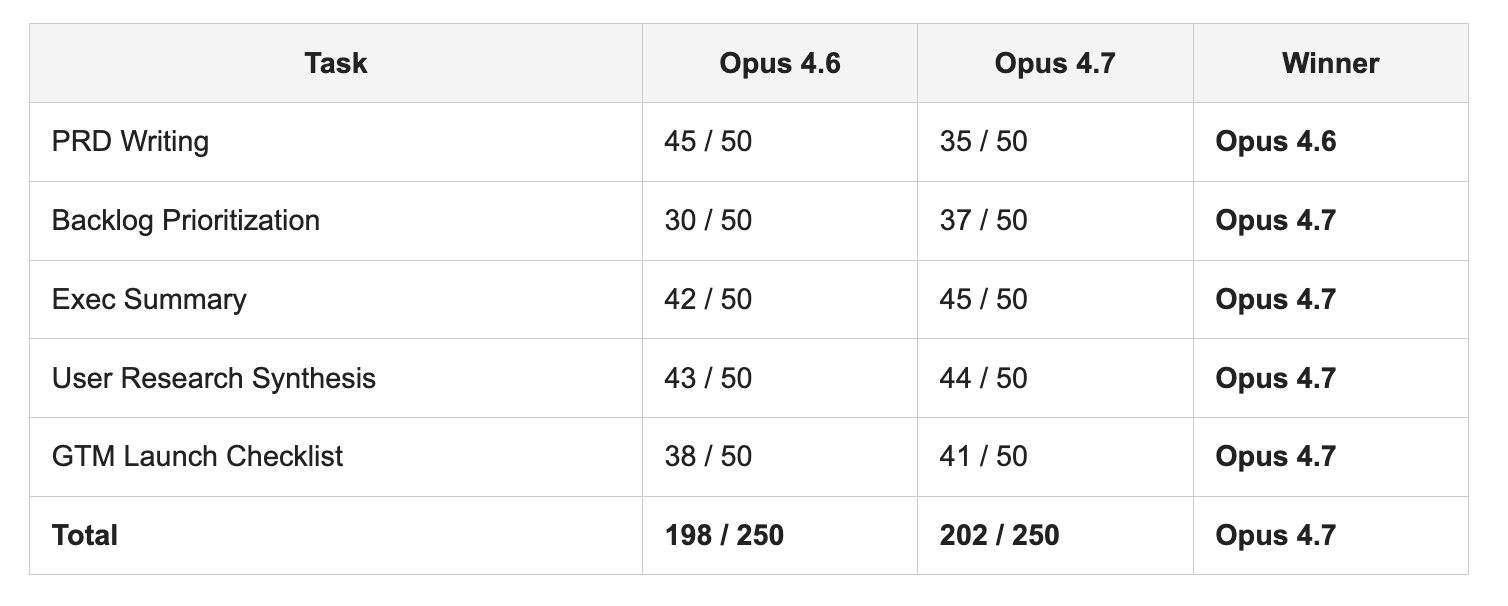
4.6 is still the better choice for PRD writing from scratch, it scored a perfect 45/50 vs 4.7’s 35/50.
If you’re launching AI features in regulated markets, 4.7 already knows about the EU AI Act. 4.6 doesn’t mention it.
The “regression” controversy and why PMs should read it differently
What the community is saying
The complaints about Opus 4.7 cluster around a few consistent patterns. Writers say long-form prose has become more mechanical. The model reaches for bullet points and headers where earlier versions held a flowing narrative. Coders say explanatory comments feel more templated. General users describe the experience as “corporate,” as if every response is being formatted for a slide deck nobody asked for.
These aren’t manufactured grievances. If you use Claude primarily for creative writing, exploratory conversation, or nuanced code explanation, the default output style has shifted in a way that works against you. The representative Reddit complaint reads something like: “It used to feel like talking to a thoughtful colleague. Now it feels like getting a memo.” For those use cases, that’s worth acknowledging.
The users driving the loudest backlash tend to be novelists, hobbyist coders, and general-purpose AI users. Their evaluation surface is fundamentally different from a PM who needs a PRD reviewed by six engineers in Confluence by Thursday.
The Benchmark setup
Claude Battle: Opus 4.6 vs Opus 4.7 for Product Managers
A head-to-head benchmark of Claude Opus 4.6 and Opus 4.7 on 5 core PM tasks, with Claude-as-judge quality scoring.
What it contains
Two scripts:
claude_battle.py— runs both models on identical PM prompts and saves raw outputs + timingbattle_eval.py— uses Claude Opus 4.7 as an independent judge to score both models on 5 PM-specific quality dimensions
The results/ folder contains the actual outputs and scores from the April 17, 2026 run (the day Opus 4.7 launched).
Why PM workflows are a different evaluation surface
PM deliverables have one thing in common that creative tasks don’t: the primary audience isn’t the person who wrote them. A PRD gets reviewed by engineering leads, design, and QA. An exec summary lands in a C-suite inbox. A RICE-scored backlog gets pulled into JIRA. The output needs to be scannable, formatted for stakeholder review cycles, and structured to slot into existing templates.
The formatting shift that feels like over-engineering in casual chat is, in that context, a feature. When your audience reads in tables and headers, a model that defaults to tables and headers isn’t regressing. It’s calibrating.
The 4.6 vs 4.7 question isn’t which model is better overall. It’s which task you’re running.
How this benchmark was structured
Every test followed the same protocol: identical prompt text, fresh session with no prior context, raw first output captured without regeneration. No fine-tuning, no system prompts, no prompt engineering. I wanted to evaluate default behavior, because most PMs aren’t prompt engineers and their first-pass output is what actually matters under deadline.
Evaluation criteria across all five tasks: output structure, information density, formatting fit, reasoning visibility, and consistency. Where the outputs diverged, I’ve included direct excerpts and comparisons. Where one model clearly won, I’ve said so.
Quality scorecard — the actual scores
Each response was evaluated by Claude Opus 4.7 acting as an independent judge, scoring five PM-specific quality dimensions from 1-10 (max score per task: 50).
Overall scores:
Scores by dimension (average across all 5 tasks):
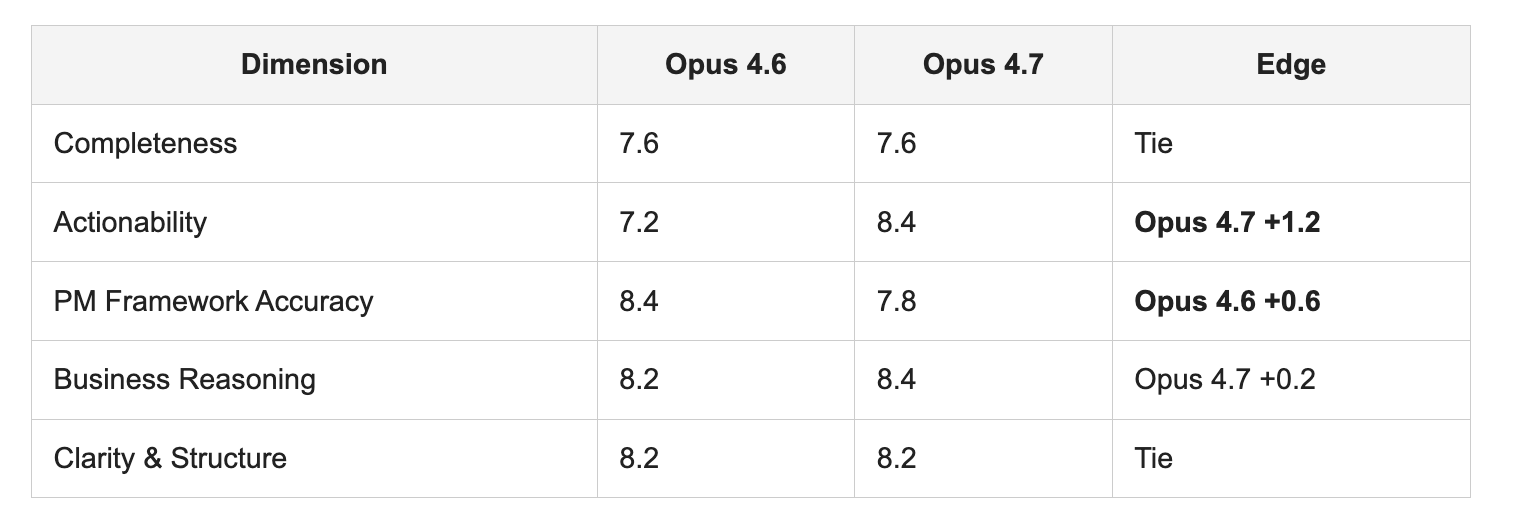
The two dimensions that split the models: Actionability (4.7 +1.2 avg) and PM Framework Accuracy (4.6 +0.6 avg). Opus 4.7 produces outputs you can act on immediately. Opus 4.6 applies frameworks like RICE with more precision when it doesn’t hit token limits.
Task 1: PRD writing (the one task 4.6 clearly wins)
What each model produced
The prompt: “Write a concise PRD for adding a waitlist to our B2B SaaS product so we can manage demand during our closed beta. Include problem statement, goals, user stories (3), success metrics, out of scope, and risks.”
Opus 4.6 produced flowing prose with strong narrative structure. The problem statement was rich with context, goals were laid out in a table, and the risk section proactively flagged GDPR/CCPA consent and data retention as a launch blocker. It read like a document written by a PM who has shipped products before.
Opus 4.7 produced a well-structured output with a clear hierarchy and checkbox-formatted user stories, then hit its token limit and cut off mid-risk statement. It literally stopped mid-sentence.
Side-by-side output analysis
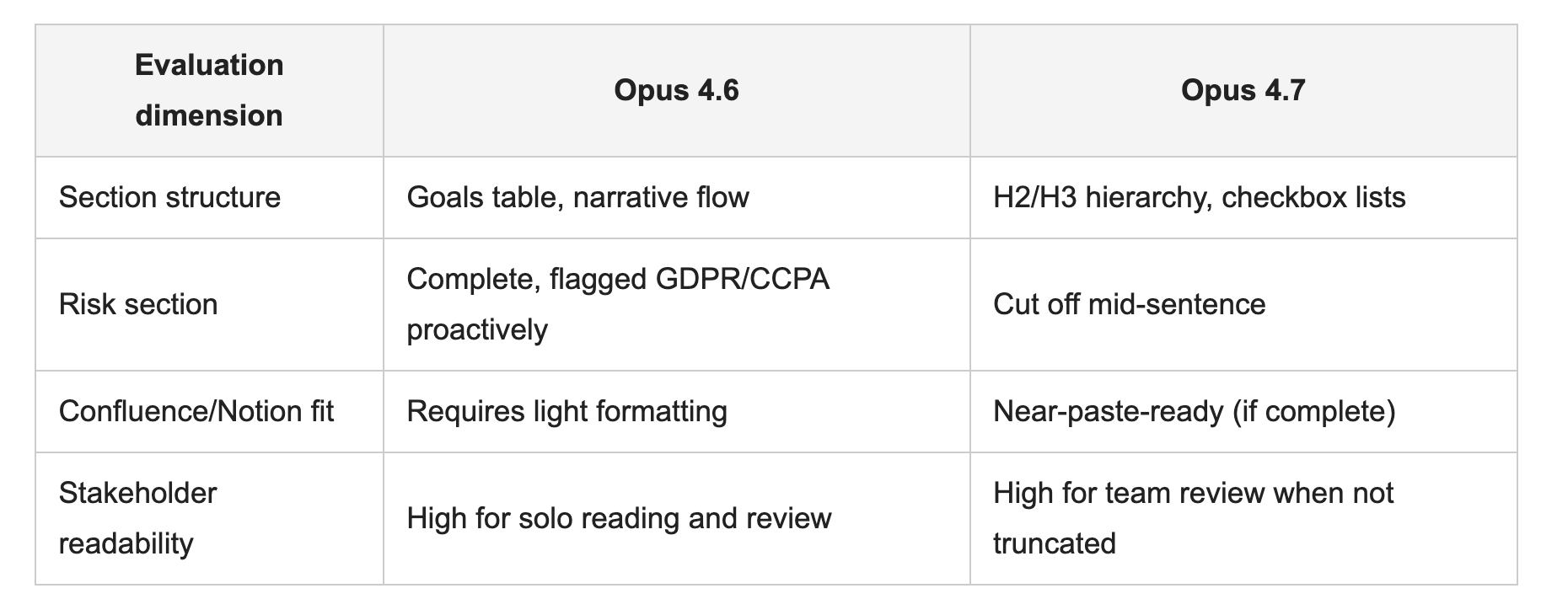
The 4.6 output scored 9/10 across all five quality dimensions. 4.7 scored 6/10 on Completeness and Clarity because it didn’t finish.
PRD verdict
4.6 wins. A PRD that doesn’t finish its risk section is going to come back and bite you in sprint planning. The completeness gap here isn’t subtle.
One important note: this is a token ceiling problem, not a capability problem. If you’re using 4.7 for PRDs, set max_tokens higher than the default. That single change likely closes the gap.
Task 2: Exec summary (where 4.6 nearly takes back a second win)
The test
The prompt: “Rewrite the following engineering spec as a 3-bullet executive summary for a non-technical VP. Focus on business impact, not implementation.”
This task rewards different output characteristics than PRD writing. A good exec summary for a C-suite audience needs rhetorical craft: a narrative arc that moves from problem to stakes to solution, and a tone that feels strategic rather than operational. Tables and bullet points work against you when you need to build urgency and make a business case feel compelling.
Where each model landed
Opus 4.6 translated an 800ms-to-120ms latency improvement into “~85% reduction in our slowest database response times.” Accurate, but it reads like a metrics report.
Opus 4.7 framed the same number as “key user actions will feel roughly 6x snappier.” That’s the version a VP can actually repeat in a board meeting. It also added “removes our current scaling ceiling” as business context, where 4.6 stayed closer to the technical framing.
The scores were close: 4.6 scored 42/50, 4.7 scored 45/50. The gap was almost entirely in Actionability and Business Reasoning.
Exec summary verdict
4.7 wins, but not by much. On default output, 4.7 frames impact the way a non-technical stakeholder reads it. If you need pure narrative prose with no structure at all, add one line to your prompt: “Write this as flowing prose with no bullet points, the audience reads for story not structure.” That largely fixes 4.7’s formatting instinct.
Tasks 3 and 4: RICE prioritization and user research (where the reasoning gap opens up)
RICE scoring
The prompt gave 6 features and asked for RICE scores, rankings, and rationale for the top 2 picks. Realistic mixed backlog: dark mode, Slack integration, CSV export, mobile app, onboarding checklist, team permissions (RBAC).
Opus 4.6 produced a clean RICE table. It also contained a problem: the scoring went feature-by-feature through the narrative, making the ranking hard to scan, and the output cut off before explaining the second top pick. It looked authoritative and wasn’t finished.
Opus 4.7 produced a summary table with all six features ranked in one view and RICE scores calculated correctly. Partway through it caught something and inserted: “Correcting: CSV export (300) actually ranks 3rd, Slack (187) 4th.” It noticed an inconsistency in its own ordering and fixed it inline. That’s the self-correction behavior.
For a PM who runs RICE scoring regularly, that kind of visible error-catching is worth a lot. A silent error in a prioritization table is the kind of thing that ships the wrong feature.
User research synthesis
The prompt: 5 raw B2B customer interview quotes. Synthesize into top 3 pain points, a Jobs to Be Done statement, and a recommended next step.
Both models correctly identified the top pain points (data export, access controls, onboarding). The difference was in what came after.
Opus 4.6 stopped at the diagnosis. Clear pain points, crisp JTBD framing, but no success metrics for whatever the team ships next.
Opus 4.7 added a recommended quarterly sequence: fix export first (highest frequency), then permissions (highest churn risk), then onboarding. It also proposed how to measure whether each fix worked. That’s the output you can bring to a sprint planning session without additional work.
Verdict for multi-step tasks
Both tasks point to the same thing: 4.7 shows its work. Whether it’s catching a ranking error or sequencing recommendations with metrics, the outputs are more auditable. In agentic workflows where Claude runs through multiple steps, a visible self-correction in step two is more useful than a polished output with a silent error buried inside it.
Task 5: GTM planning (the AI-era awareness gap)
The prompt
“Create a go-to-market launch checklist for a new feature: ‘AI-powered meeting summaries’ being added to an existing B2B SaaS productivity tool with 2,000 paying customers.”
This prompt was designed to surface AI-era awareness, specifically whether either model would flag the regulatory and operational concerns that come with shipping an LLM-powered feature.
What 4.6 missed
Opus 4.6 produced a solid three-phase GTM checklist covering internal readiness, customer communication, and success measurement. The risk section identified standard enterprise SaaS risks: competitive displacement, low adoption, integration complexity. It didn’t mention the EU AI Act, GDPR Article 22 implications for automated decision-making, or LLM cost monitoring as an operational concern.
For a PM launching an AI product in Europe in 2026, that’s a meaningful gap in the checklist.
What 4.7 added
Opus 4.7’s checklist included explicit items for EU AI Act compliance (classifying the feature’s risk tier), GDPR data residency requirements for model inference, and a note to set usage caps to prevent runaway LLM spend. It recommended a phased rollout sequenced against the EU AI Act’s compliance timelines.
Training cutoff explains part of it, but 4.7 also surfaces these requirements in the context of PM decisions, not just as a legal checklist bolted on at the end.
GTM verdict
4.7 wins, especially for any PM working on AI features or in regulated markets. If your GTM plan doesn’t touch AI or Europe, the gap narrows considerably. But if it does, 4.7 is the only one of the two that doesn’t require you to manually fill in what it missed.
Frequently asked questions
Is Claude Opus 4.7 better than 4.6 for product managers?
Depends on the task. For structured deliverables, RICE scoring, GTM planning, and multi-step agentic workflows, 4.7 is the stronger choice. For PRDs from scratch and persuasive narrative writing, 4.6 holds its own.
What is the Claude Opus 4.7 benchmark performance for PM tasks?
Across five tasks, 4.7 won four (backlog prioritization, exec summary, user research synthesis, GTM planning) and lost one (PRD writing, where 4.6’s completeness was decisive). Overall scores: 202/250 for 4.7 vs 198/250 for 4.6.
Why are people saying Claude Opus 4.7 is a regression?
The regression complaints are largely valid for creative writing and conversational use. The formatting shift toward tables and structured output works against those use cases. For PM deliverables that need structured, stakeholder-ready output, the same behavior is often a feature.
What is mid-output self-correction and why does it matter?
It’s when Claude 4.7 identifies an inconsistency during generation and explicitly flags and corrects it in the same output. For agentic workflows where errors compound across iterations, this is more useful than polished output with silent logical errors inside.
Should I upgrade from Claude Opus 4.6 to 4.7?
Use it as a routing rule: if the output is going into a structured template reviewed by stakeholders, use 4.7. If it’s a narrative draft you’ll heavily edit yourself or a persuasive doc for a non-technical audience, stay on 4.6 or add an explicit prose instruction.
Conclusion
The community backlash against Opus 4.7 is real, and for the use cases driving it, it’s not wrong. But it’s not the full picture for PMs.
Across five core tasks, 4.7 won four. It traded narrative fluency for structured output, and surface polish for visible reasoning. For PM workflows, most of those trade-offs work in your favor. The one exception is PRD writing from scratch, and even that comes down to a token limit you can adjust.
The self-correction behavior is the thing worth watching most closely. Models that show their work integrate more cleanly into multi-step PM workflows than models that return polished outputs with silent errors. For agentic use, that difference matters more than surface polish.
Route your structured deliverables through Opus 4.7. Keep 4.6 for narrative writing. And if you’re building AI features or operating in regulated markets, 4.7 already knows the compliance landscape you’re navigating.
Have you run your own comparisons between 4.6 and 4.7?
Drop your findings in the comments, particularly if you’ve stress-tested the self-correction behavior on longer agentic chains. I’m building a follow-up test on five-step roadmap generation loops and the more real-world data points I have, the better.
Sources
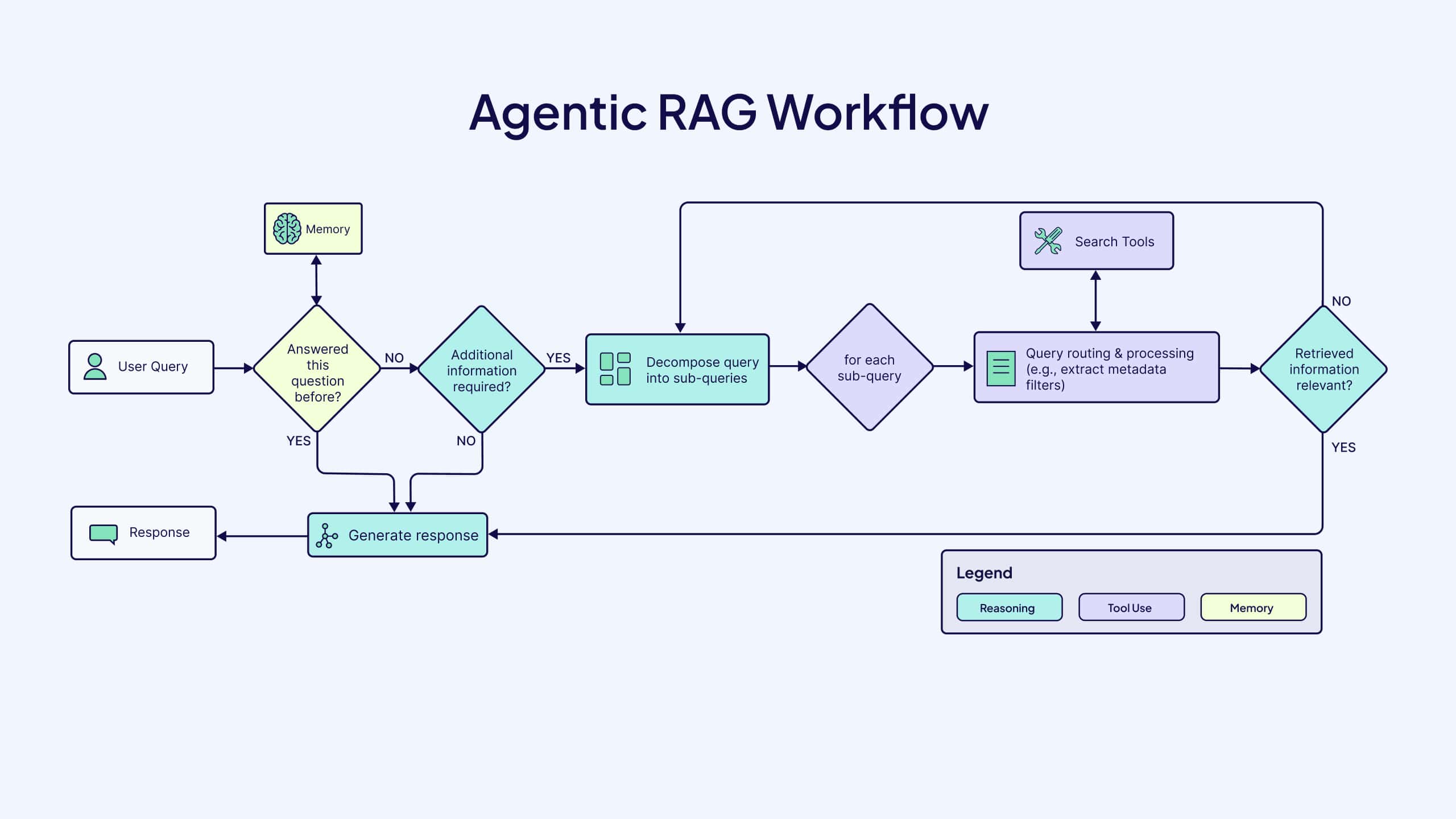
https://weaviate.io/assets/images/agentic-search-workflow-2b8e44550b28c263f52c18e1d8b7ca1f.jpg
https://www.reddit.com/r/ClaudeAI/comments/1soew2x/claude_opus_47_won_69_of_100_blind_evals_against/
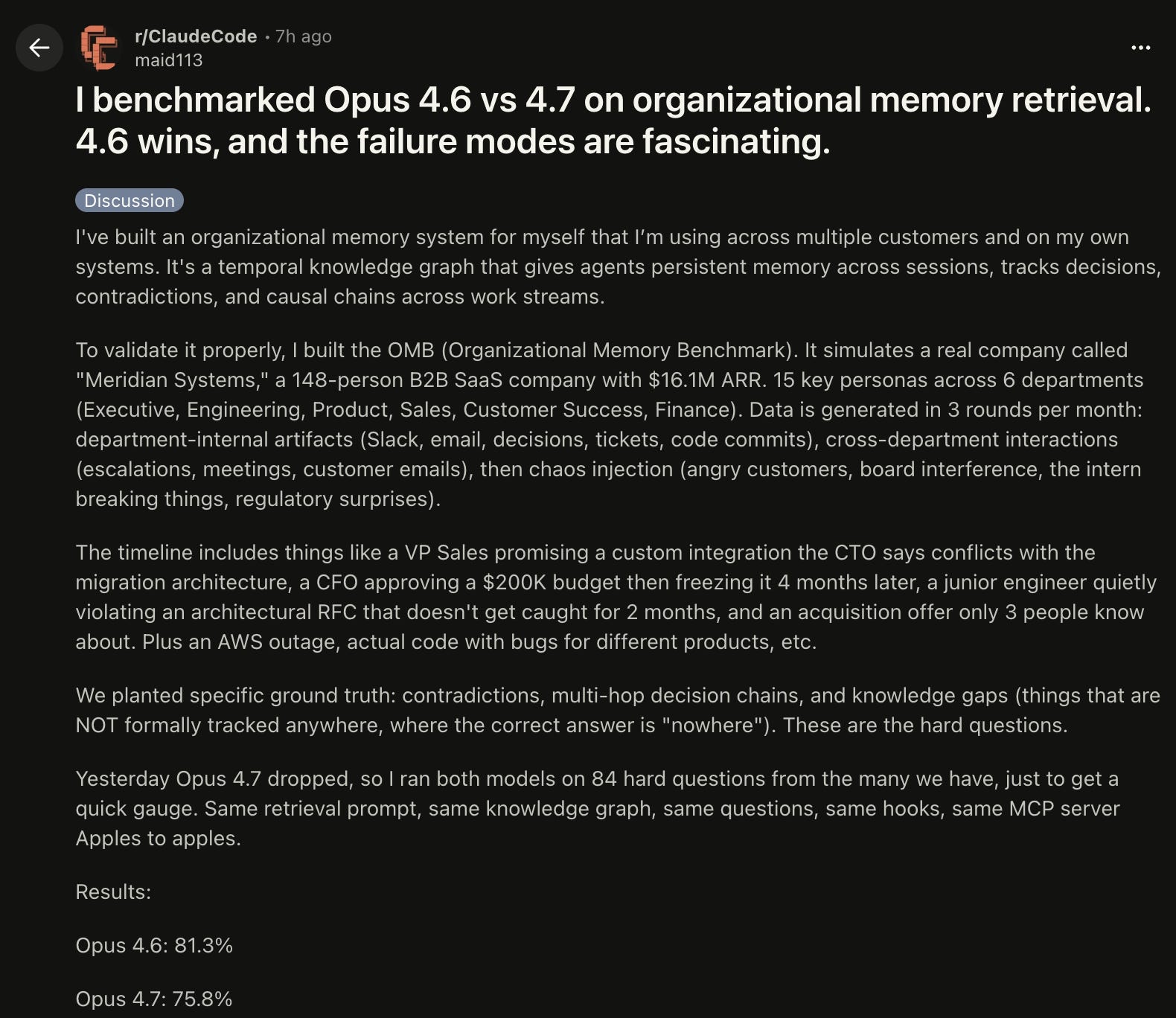
https://www.reddit.com/r/ClaudeCode/comments/1soes75/i_benchmarked_opus_46_vs_47_on_organizational/
💡 Want to share your work on my socials with my 15k+ audience?
If you build a project you are excited about, I will be too. Trust me! I love seeing people build cool stuff. To share it, you can contact me here.
Did you enjoy this post?
Here are some other AI Agents posts you might have missed:
KV Caching and Speculative Decoding
A deep dive into Quantization: Key to Open Source LLM Deployments
Agents are here and they are staying
How Agents Think
Memory – The Agent’s Brain
Agentic RAG Ecosystem
Multimodal Agents
Scaling Agents: Architectures with Google ADK, A2A, and MCP
Fully Functional Agent Loop
Ready to take it to the next level? Check out my AI Agents for Enterprise course on Maven and be part of something bigger — join hundreds of builders developing enterprise-level agents.

Use this link to get $201 OFF!
You’re receiving this because you’re part of our mailing list. We don’t spam or sell your information. To unsubscribe, use the link below.